
Nov. 19, 1970: One Completed At Filtration Plant

Originally published in The Vidette-Messenger of Porter County on November 19, 1970.

One Completed At Filtration Plant

By BETTY MISCH

A two-year undertaking at Flint Lake Water Department is now well underway with the completion of one of four new rate controllers being built by the department, Philip Coote, chief engineer, has reported.

The rate controller is an automatic device that controls the amount of water flowing through the filters at the plant in relation to the cleaness of the filters. An indicator shows when filters need back washing. Don Ungurait, pumping station superintendent, explained.

The present manually-operated system has been in operation since 1950. The new automatic, more accurate system is designed to produce better quality water and at the same time, increase efficiency, Coote said.

Old valves are gate valves, Ungurait explained, while new ones being installed are butterfly valves, the newest thing in water works. “They should hold up better, last longer, and be more efficient,” he added.

Actual water flow of the new system will be regulated electronically. After flow rate is set, a signal from the metering device will automatically control the flow rate.

New control valves are operated by push buttons instead of the manually-turned wheels used in the old system, the men explained.

The project, approved by the Valparaiso Water Board in February, was begun as soon as valves were delivered by the Henry Pratt Co., Aurora, Ill., and electrical components were received from the Hayes Corp., Michigan City. Total cost of valves and electrical components for one rate controller was nearly $3,000.

A great deal of the cost of the new unit is saved by the department building it. If contracted for installation, each unit would cost an estimated $4,000, Coote noted.

The old manual type rate controllers which have been in use are no longer allowed by the State Board of Health. New valves will give a higher quality product and better control of water filtration.

Operation of the Valparaiso Water Department’s filtration plant at Flint Lake was started in 1907, only two years after the first filtration plant began operation in the United States.

At that time, two filter beds were built. A third bed was added in 127, and a fourth in 1950. With the increase in population, further expansion will be necessary in the future, Coote noted.
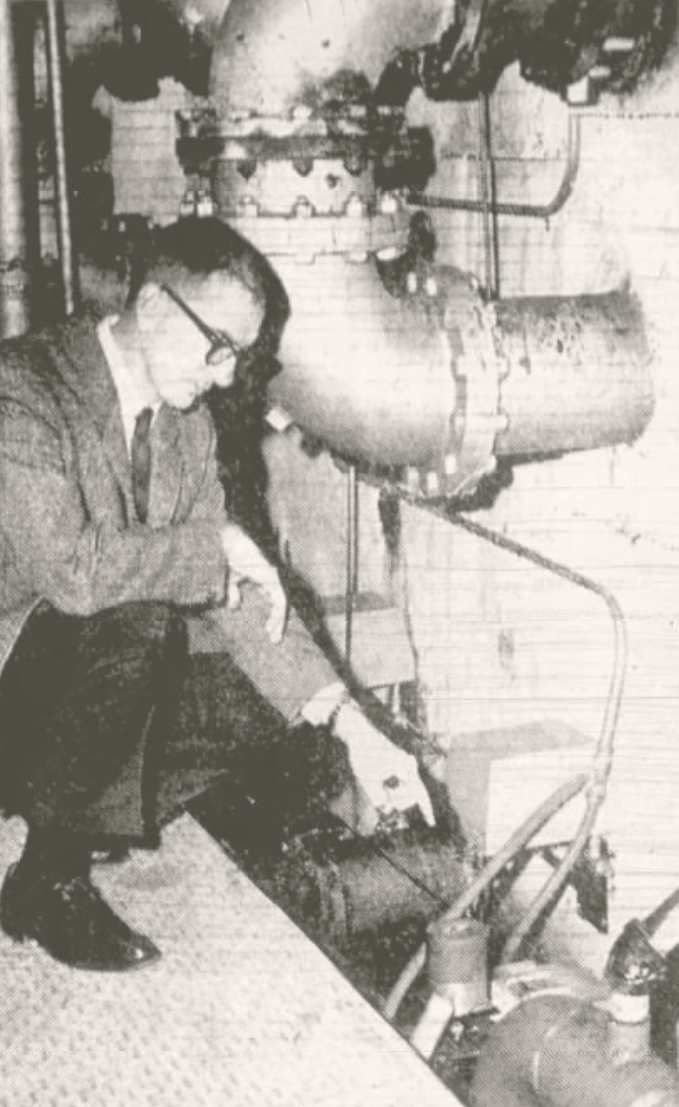
Installing 4 New Rate ControllersPhilip Coote, chief engineer of Valparaiso Water Department, (in photo at top) points out newly installed rate control valve, part of new filtration system being built by department.

Installing 4 New Rate Controllers

Philip Coote, chief engineer of Valparaiso Water Department, (in photo at top) points out newly installed rate control valve, part of new filtration system being built by department.

Installing 4 New Rate ControllersCoote explains how old water filtration system worked

Installing 4 New Rate Controllers

Coote explains how old water filtration system worked

Installing 4 New Rate ControllersDon Ungurait, plant superintendent, explains new push-button control panel. New system, which will take two years to complete, will be more accurate than present system.

Installing 4 New Rate Controllers

Don Ungurait, plant superintendent, explains new push-button control panel. New system, which will take two years to complete, will be more accurate than present system.

Nov. 18, 1955: Students Help Defoliate Trees and European Refugee To Live Here

Originally published in The Vidette-Messenger of Porter County on November 18, 1955.

Its Class Project

Students Help Defoliate Trees

By KAREN ANGLE

As winter arrives and the snow falls, the trees become barren. But this condition is due not only to the onslaught of the some 275 Valparaiso High school biology students.

Comprising nine different classes, these freshmen were required at the beginning of the year by their teachers, Miss Pat Bushong and Paul W. Miller, to collect, press, mount, and identify at least the 25 most common leaves in the state of Indiana. These collections were due today. Both the common and scientific names were to be given.

Some of the students turned in more than 100 leaves. The time collecting their material was spent entirely out of class. Many of the freshmen parents, in helping to collect, mount, and identify the leaves, claim to have learned almost as much as the students.

Slides of the 25 most common leaves have been made by Miller, and will be used during the coming week to test the students to see how much they have learned from their collections. After they have been graded, if there are enough outstanding collections, they will be displayed in the window of a local merchant, as has been done in the past.

Next semester the biology students can have their choice of writing a term paper or submitting a project having to do with any phase of life or living things.

Sponsored By Kazlauski

European Refugee To Live Here


A 29-year-old European refugee, sponsored by a RFD 2 couple, is expected to arrive in Valparaiso the latter part of next week, where she will find a home and a job awaiting her.

She is Miss Herta Deringas of Lithuania, and is being sponsored by Mr. and Mrs. Alex Kazlauski.

Mrs. Kazlauski met Miss Deringas at a refugee camp in Germany while she was on a trip to Europe in September of 1954 to visit with her son, Albert, who is a dentist in the Armed Forces.

Since Mrs. Kazlauski is a native of Lithuania, she was able to converse with the girl in her native tongue and found that the refugee was acquainted with August Pupelis, another Lithuanian, who was sponsored by the Kazlauskis more than five years ago. Pupelis now works for the Kazlauskis. When she returned to the states Mrs. Kazlauski and her husband started proceedings to have Miss Deringas come to the United States.

Mrs. Kazlauski came to the United States when she was 3 years old and her husband. Alex came to the states when he was 19 years old. Both are now American citizens.

Miss Deringas will live in the Kazlauski home and will work in the Vale City Packing company which is owned by the Kazlauskis, it was stated.

The Lithuanian woman is one of the 15 European refugees ― headed for Indiana homes ― that will arrive in New York Monday aboard the Navy Transport General Langfitt, it was announced today by the State department.

Nov. 18, 1930: MAN WHO LOST EYE FOR CAUSE TO VISIT CITY: Porter County Liquor Foes Planning Great Rally as One of Banner Events of Month.

Originally published in The Vidette-Messenger of Porter County on November 19, 1930.

MAN WHO LOST EYE FOR CAUSE TO VISIT CITY

Porter County Liquor Foes Planning Great Rally as One of Banner Events of Month.

‘PUSSYFOOT’ JOHNSON IS THE HEADLINER

“Pussyfoot” Johnson is coming!

What’s the big news broadcasted to all Porter county foes of liquor and champions of prohibition.

He will be in Valparaiso Wednesday evening, Nov. 26, to speak in the Methodist church auditorium as part of his “invasion” of Indiana in the interest of the dry cause, which will carry him into the principal cities of the state.

With Johnson, whose real name is William E. Johnson, will be Lt. Col F. B. Ebbertーthe man who as a lawyer defeated the efforts of Clarence Darrow and Levy Meyer noted Chicago attorneys, and got the signature of Gov. Frank O. Lowden to Illinois’ prohibition enforcement act, back in 1919ーthe days of the “big battle” for the eighteenth amendment. Col. Ebbert won rank in the Spanish-American and World wars.

But, as for the past twenty-five or more years, it is “Pussyfoot” Johnson who holds the spotlight.

He is rated as the “biggest oratorical gun” in the prohibitionist army.

He comes to Valparaiso under the auspices of the Anti-Saloon League of America in co-operation with the Indiana Anti-Saloon League.

He will be entertained here by the City Ministerial association. Following is a summary of Mr. Johnson’s career was drafted by Rev Carl Stewart, pastor of Valparaiso Baptist church: “No speaker against the liquor traffic has so caught the imagination of the world as has “Pussyfoot” Johnson. This comes partly from his colorful activities of twenty-five years ago when he was commissioned by President Roosevelt to “cleanup” the old Indian territory under the very wild conditions that prevailed in that bad-lands at that time. The territory had become the rendezvous for murderers, robbers, and all sorts of unruly people who fled into the territory for hiding places and, for ready money, were selling liquor to the Indians and committing all sorts of depredations.

“There were only four courts to take care of the civil and criminal business of the territory. Because of the inadequate provision for dealing with the outlaws, more than 6,000 criminal cases had piled up on the dockets which would require ten years to handle, to say nothing of the new cases that might be brought. Because of this condition, the outlaws felt that they could do as they liked and get away with it. Naturally, chaos resulted when Johnson met that situation by dealing with the outlaws without much law and in a rough and tumble fashion.

“The first thing he did was to seize and summarily destroy 76 gambling houses, piling the furniture and fixtures on the streets and setting fire to them, acting under an old Arkansas statute that Congress had enacted to apply to the territory. He cleaned out every gambling house. Plot after plot was made against his life but they all miscarried. One of his friends was not so lucky and was killed by mistake and part of the $3000 reward that the outlaws had posted against Johnson was collected before the brigands found they had the wrong corpse.

“During the six months that this reward was hanging over his head, Johnson conducted his operations almost wholly at night, using stealthy, surprise tactics. It was because of these methods that he acquired the nickname, “Pussyfoot.” eight of his deputies were murdered and many others were shot or stabbed. One of his deputies still carries a bullet in the back of his head which was never extracted; one is speechless because of being stabbed in the throat, cutting the larynx and destroying his vocal cords. At one time Johnson had four sets of orphan children on his hands whose fathers had been murdered by the liquor sellers and gamblers; but these tragic deaths only added to the fury of Johnson in dealing with the offenders. In later years, after his wife had died, he married the widow of a slain deputy. For six years he fought the outlaws on their own grounds and to some extent using their tactics.

“After leaving government service in 1912, he attached himself to the Anti-Saloon League, playing an important part in various statewide campaigns for prohibition, handling the publicity operations in most of the western states that “went dry.”

“His next move, in 1918, was to go to Europe where he opened an office in London, which office he still maintains. In a riot in London one of his eyes was destroyed, and now a glass one takes its place. Contrary to all expectations, he declared it was only a “joke” and took no action whatever for redress. When London admirers collected a fund of nearly two thousand dollars as a tribute to his “sportsmanship,” he immediately turned the money over to a hospital for blind British soldiers, and his fame thereupon soared skyward. Johnson has traveled three times around the globe, speaking in practically every country in the world outside of South America, and is still “going strong.”

Nov. 17, 1930: LONDON DEMANDS VOTE RECOUNT SAYS BALLOTS WERE REMOVED FROM POLLS

Originally published in The Vidette-Messenger of Porter County on November 17, 1930.

LONDON DEMANDS VOTE RECOUNT

SAYS BALLOTS WERE REMOVED FROM POLLS

County Clerk, Defeated by Joseph L. Doyle, Democrat, by 62 Votes, Files Petition in Circuit Court.

3 COMMISSIONERS TO BE NAMED SOON

A recount of the vote cast in the November 4 election for the office of Porter county clerk was asked in a petition filed in the Porter circuit court Saturday by Mae R. London, present incumbent. According to the official returns, Mrs. London, running for re-election, was defeated by Joseph L. Doyle democrat, by sixty-two votes.

Mrs. London, in her petition, alleges that the election boards unlawfully and fraudulently permitted ballots and pencils to be removed from the polling places which were illegally done for the purpose of permitting and procuring illegal votes to be cast.

It is also asserted that persons were permitted to remain in the room where the votes were being counted who were not permitted under the law to be in the room.

The election boards in the forty-one precincts of the county are also charged with failing to count many legal ballots cast at the election, and permitted persons to vote whose right to do so had been duly and legally challenged.

Hedge Grant Crumpacker ordered the recount, and will name three commissioners within a few days. Two of the commissioners will be selected from republicans and one from democrats.

Counting and examination of the ballots cast at the November 4 election will require four or five days, it is estimated. In addition to the duty of examining the ballots counted by the board, those thrown out as mutilated must be examined and passed upon.

Mrs. London was apparently defeated by Doyle by a vote of 3,789 to 3,727.

Nov. 17, 1955: 66 Schools Disappear From Porter County System In 83 Years, Survey Indicates

Originally published in The Vidette-Messenger of Porter County on November 17, 1955.

66 Schools Disappear From Porter County System In 83 Years, Survey Indicates

Salaries of teachers and township trustees have rocketed, school enrollment in Porter county has almost exactly doubled, but 66 schools have disappeared in the past 83 years.

This information was gleaned from a copy of the 20th report of the Superintendent of Public Instruction in Indiana, Milton B. Hopkins, published in 1872, and recently obtained by Porter County Supt. of Schools M.E. Dinsmoore. It is the property of James W. Dold, Chesterton High school principal.

Eighty three years ago in Porter county, according to this report, elementary teachers’ salaries averaged $1.60 a day for men and $1.20 a day for women, and salaries in the county, both men, averaged $4.50 daily. Today, according to the county superintendent’s office, teachers in Porter county earn an average daily salary of about $20.

There are 297 teachers in the county school system now, only 115 more than 1872, when there were 182 teachers. Yet total county school enrollment since that time has increased from 3,700 to 7,468.

The exception is Jackson township, where school enrollment, officially 196 now, shows a decrease of 33 since 1872.

Eight times as many pupils in Westchester and 10 times as many in Portage since 1872 are evident, with increases of about 1,500 and 1,900 respectively since that time. Westchester’s enrollment is now 1,733, and Portage’s 2,105, officially.

Increased Enrollment

Enrollment increases varying from 150 to 300 are evident in Pleasant, Boone, Liberty, Center and Pine township. During the past 83 years, increases of only 20 to 60 pupils took place in Morgan, Union, Washington and Porter townships.

Yet, to house these additional 3,700 students, there are now 24 county schools ー 66 less than in 1872.

“The county was full of one-room school houses then,” Supt. Dinsmoore pointed out.

Obviously, these one-room, or slightly larger, schools were worth little compared to today’s modern educational structures. The 90 in the county in 1872 had a total value of $95,000, according to the report, or about $1,000 each. Valuations of the schools in Porter county now vary from $26,900 to $600,000, officials said.

1872 Salaries

The township trustees who ran the Porter county schools in 1872 earned annual salaries of $423 each, the report states. Today, their yearly salaries, in addition to various allowances, vary from $1,400 to $2,700, depending on the size of the township.

And even as early as 1872, there was agitation to abolish the present system of having one township trustee run the civil and school affairs of each township. The state superintendent, in his report, offered the following statement:

“Why the civil and educational business should be kept separate in incorporated towns and cities, and united in the same person in townships, I am unable to understand… I recommend that the law be so amended that the qualified voters of each school corporation… elect three school trustees for a term of three years.”

Nov. 16, 1960: Halleck Wins By 25,456; Nixon Captures Indiana By 22, 762 Vote Margin

Originally published in The Vidette-Messenger of Porter County on November 16, 1960.

Halleck Wins By 25,456; Nixon Captures Indiana By 22, 762 Vote Margin

INDIANAPOLIS (AP)ーThe final official vote counts in the Nov. 8 election show Vice President Richard M. Nixon carried Indiana by 222,762 votes in his lost cause for the presidency.

The official canvass announced today by the secretary of state’s office gave Nixon 1,175,120 to capture the state’s 13 electoral votes. President-elect John F. Kennedy got 952,358.

In the race for governor, Democrat Matthew E. Welsh won by a 23,177-vote margin ー 1,072,717 to 1,049,540 for Lt. Gov. Crawford F. Parker, Republican.

Final results for four district congressional races, delayed by late - reported totals from several county clerks, showed:

2ndーGeorge H. Bowers, D-Valparaiso, 70,464: Rep. Charles A. Halleck, R-Rensselaer, 95,920.

9thーRep. Earl Hogan, D-Columbus, 69,761; Earl Wilson, R-Bedford, 71,402.

10thーRep. Randall S. Harmon, D-Muncie, 78,716; Raph Harvey, R-New Castle, 104,885.

Bruce By 21,000

11thーDonald C. Bruce, R-Indianapolis, 154,676; Rep. Joseph W. Barr, D-Indianapolis, 133,153.

Official final tallies in Indiana’s seven other congressional districts reported Tuesday showed Republican victories in the 4th, 5th 6th and 7th districts.

Rutherford L. Decker, Prohibition party nominee for President, received 6,746 votes in Indiana, and the choice for governor, J. Ralston Miller, received 5,392.

Eric Haas, Socialist Labor nominee for President, got 1,136 votes, while the party’s nominee for governor, Herman A. Kronewitter, received 816.

Nov. 15, 1985: Kouts church to celebrate 100th anniversary

Originally published in The Vidette-Messenger of Porter County on November 15, 1985.

Kouts church to celebrate 100th anniversary

by Carolyn Matthews

Staff writer


KOUTS ー A Founder’s Day will be observed Sunday when the Kouts Christian Church celebrates its 100th anniversary.

A Founders’ Day coffee hour with a slide presentation will be held at 9 a.m. Sunday followed by a special worship service at 10 a.m. Members will be dressed in the 1885-era clothing and a Founders’ Day dinner will follow.

Dr. Kingery Clingenpeel, who has served as pastor for the past 11 years, said the Christian Church finds its heritage as the “melting pot” of many other denominations.

A significant portion of the membership claims little or no church background, he said. Baptists, Catholics, independent Christians, Mennonites, Disciples of Christ, Nazarenes, Methodists, Lutherans, Episcopalians, and Presbyterians worship at his church.

According to church history, in the spring of 1885 the Lyman Adkins family and a night marshal, turned evangelist, helped to start the church.

Adkins was the town physician and druggist. Ellis B. Cross was a young night marshal in the mining town of Leadville, Colo. during the years of the lawless West.

Since there were no ministers in Leadville when Cross served as marshal, it was his duty to notify the next of kin when someone was killed in a gunfight. It was also his responsibility to arrange and conduct funeral services. As a result of this experience Scott decided he wanted to become a minister.

A native of Lowell, Scott, 20 years old, returned to Indiana where he attended Garrett Biblical Institute and Valparaiso University. According to VU records he was enrolled in the department of elocution and orator.

It was during Scott’s student days that he teamed with Adkins to launch the Kouts Church. The population of Kouts at that time was 215.

In June of 1885 the first baptismal services for what was to become the Christian Church was held in the waters of the Kankakee River.

The first church was constructed and dedicated in 1887 on land donated by Mrs. Rose Yoder.

In May of 1917 a tornado hit Kouts and the little church, along with the Kouts Catholic church, was destroyed.

Members salvaged what materials they could and built a new building, completed in March of 1919.

A few years later a belfry was added and the bell from the original 1887 frame church was installed. The same bell is mounted in a tower in front of the present church on Poland Street.

The Rev. John Whitt served as pastor for the next nine years until his death in the summer of 1928. Following Whitt’s death, the Christian Church suffered a period of decline and was forced to close its doors for 14 years.

The building was rented to the Kouts School for graduation services in 1936. The Reformed Mennonite congregation also rented the church for portions of the next several years.

In 1943, with less than $250 in the treasury, the Christian Church reopened its doors. Arthur Brewer was paid $5 per week for his sermons.

A decade later, Mrs. Loey Unruh willed the current parsonage to the church.

A new church was completed and dedicated in April of 1971.

11.15.1985 pic.png

Nov. 14, 1960: Yule Decoration Plans Fashioned

Originally published in The Vidette-Messenger of Porter County on November 14, 1960.

Yule Decoration Plans Fashioned

Merchants Bureau of the Chamber of Commerce today issued an appeal for organizations again to participate in the courthouse lawn christmas decoration program.

Bureau Chairman George Neeley said that organizations which have participated in the past as well as others are urged to begin making plans for a display on the courthouse lawn.

Entrants again are urged to use a religious theme in their display.

As in the past, a committee of three judges will inspect the displays and four prizes will be awarded. The four savings bond prizes will be $100, $75, $50 and $35 for first, second, third and fourth places Neeley said.


Santa To Arrive

Organizations planning to erect displays on the courthouse lawn are urged to contact the Chamber of Commerce office or Neeley. The courthouse building again will be decorated with lights prior to Christmas.

Neeley said Santa’s house will again be erected on the courthouse lawn. St. Nick’s headquarters building now is being renovated.

NOT RUSHING SEASON“We’re not trying to rush the Christmas season,” Merchants Bureau Chairman George Neeley said today in explaining why business district holiday decorations have been hung already.“We’ve let a contract to an outside firm to install,…

NOT RUSHING SEASON

“We’re not trying to rush the Christmas season,” Merchants Bureau Chairman George Neeley said today in explaining why business district holiday decorations have been hung already.

“We’ve let a contract to an outside firm to install, maintain, and take down the new decorations. This firm has contracts with other cities and has to follow a schedule in fulfilling its various contracts, said Neeley. “We feel this an efficient, stream-lined program. The company will maintain the decorations and will take them down the first week in January.”