May 8, 1981: Planting for Mom

Originally published in The Vidette-Messenger of Porter County on May 8, 1981.

Planting for Mom


Primary teachers and 85 students from Brummitt School in Chesterton stopped at the Samuelson Nursery Thursday on their way to lunch at the Dunes National Lakeshore. With the help of nursery owners Max and Fran Samuelson, each child planted a plant (we can’t tell what it is) for their mothers for Mother’s Day. To keep the plant a secret until Sunday, only fathers were allowed to chaperone the trip

Teacher Alma Hall uses the colorful and fragrant setting to talk to the students about the wildflowers they will hunt for at the park after lunch.(V-M photos: Nancy Pekarek)

Teacher Alma Hall uses the colorful and fragrant setting to talk to the students about the wildflowers they will hunt for at the park after lunch.

(V-M photos: Nancy Pekarek)

Nick Dailey (above) packs soil around his special plant.(V-M photos: Nancy Pekarek)

Nick Dailey (above) packs soil around his special plant.

(V-M photos: Nancy Pekarek)

During the tour (above) the children walked through greenhouses, saw flowers being watered, looked at various seedlings and learned how the soil is cleaned by being baked in a hopper.(V-M photos: Nancy Pekarek)

During the tour (above) the children walked through greenhouses, saw flowers being watered, looked at various seedlings and learned how the soil is cleaned by being baked in a hopper.

(V-M photos: Nancy Pekarek)

May 7, 1956: Multiflora Roses Planted At Dunes State Park

Originally published in The Vidette-Messenger of Porter County on May 7, 1956.

Multiflora Roses Planted At Dunes State Park


RICHARD ALLISON, VHS shop teacher (upper right), directed multiflora roses planting Saturday at Dunes State Park to prevent erosion on sandy slopes. The first shift planted about a thousand of them when the rains came. Edward Weisse, of Chesterton, assistant principal of Evans school, Hobart, was in charge of the group camp which included 110 pupils of the sixth to eighth grades at Evans school.

5.7.1956 pic (1).png

May 6, 1961: ART WORK

Originally published in The Vidette-Messenger of Porter County on May 6, 1961.

ART WORK

5.6.1961 pic.png

Westville authorities have attributed ‘art work’ on east side of sewage disposal plant, to ‘group of persons physically grown up but mentally about eight to nine years old.’ Cost of covering up artistic endeavor will eventually come out of taxpayers’ pocketbooks, it was noted.

(V-M Staff Photo)

May, 5, 1956: Castoff Paper, Boxes Are Used To Create Varied Holiday Items

Originally published in The Vidette-Messenger of Porter County on May 5, 1956.

Castoff Paper, Boxes Are Used To Create Varied Holiday Items

By ROLLIE BERNHART

Mrs. Hazel Russi has an affinity toward castoff foil, old paper and cardboard boxes.

To the majority, these items are relegated to the rubbish pile. But not Hazel Russi.

Under her nimble fingers and artistic talents are created a host of useful and attractive articles for many occasions.

In her workshop, on Indiana 49 near Flint Lake school, Mrs. Russi creates table favors and center pieces for every holiday event of the year.

Surrounding her as she works are perfectly balanced scaled for a baby shower, made from old cardboard, string and coat hanger wire; a fluffy, white lamb, put together from an old salt box, together from an old salt box, four pieces of paper mailing tube, wadded newspaper and cotton; and bird houses of cardboard, artfully and realistically painted so that not even a wandering bird would know it was not the real thing.

Got ‘Bug’ As Child

The former Hazel Bright, a lifelong resident of this city, says she has had the “artistic bug” since she was a youngster, when she confined her talents to copies of comic strip characters.

Her love for art humorously asserted itself when as a child attending church with her mother, she drew candid pictures of individuals sleeping during the minister’s sermon.

She began working with paper in a Sunday School class at the Baptist church, teaching children how to make useful items from cast-off headed for the furnace.

Four years ago, she began to regard her creative talent seriously, and has since dressed many an anniversary, birthday, wedding and graduation party table with her attractive layout.

Hangs From Ceiling

Her largest project and most creative work to date is a wedding center piece made from a “junked” parasol, a piece of bamboo and some expert cutting and twisting of crepe paper.

Out of an order for a baby shower creation came a ceiling hanging work of art which she calls “Lady in Waiting”, depicting an anxious mother-to-be watching a stork fly around trying to catch up with a baby on a cloud.

Her workshop is filled with a multitude of interesting items. It is a revelation to see what can be done with paper which ordinarily would be thrown away.

She has a standing order with all who know her: “Don’t throw it away, Save it for Hazel”.

5.5.1956 pic1.png

Artful Creations For Many Occasions

A BABY SHOWER centerpiece is shown (top) being completed by Mrs. Hazel Russi, Flint Lake, who makes a variety of artful creations from castoff birthday reminder to a 50th wedding anniversary are shown below.

(V-M Staff Photos)

5.5.1956 pic2.png

May 4, 1946: DRASTIC DIMOUT HITS CITY LIFE

Originally published in The Vidette-Messenger of Porter County on May 4, 1946.

DRASTIC DIMOUT HITS CITY LIFE

Local Industry, Business, Civic Affairs Curtailed Sharply By Electric Ban

Plant Managements Struggle To Revise Work Schedules; Merchants Restricted To Short Hours; Entertainments Affected

Seriousness of the current dispute between coal mine operators and the United Mine Workers was brought home to Valparaiso and environs today with a jolting impact.

Acting on orders from the state public service commission, the Northern Indiana Public Service company late Friday distributed to local merchants and industries are effective immediately and will continue until a perilously low stockpile of coal is replenished with “normal deliveries” from the mines.

Under the order, business and manufacturing in Valparaiso comes under drastic curtailment. Local industry is ordered to use electric power no more than a total of 24 hours during any period between Monday and Friday of each week. No use of power permitted Saturdays and Sundays.

Plants Hard Hit

This meant that local plants, dependent upon electric power, now operating in some instances on a three-shift basis, will be forced to reduce schedules to one three-shift day, three days of eight hour shifts, six days of four-hour shifts, or a similar arrangement.

Management in Valparaiso industries was reported this morning to be struggling with the problem of compliance with the order which will mean layoffs for hundreds of workmen or severely reduced work weeks.

Realizing the extent of the emergency presented, NIPSCO officials were allowing a “grace” period for the readjustment, but full compliance was expected by early next week.

Commercial users, which includes virtually every merchant in town, are limited to 24 houses weekly, from Monday to Saturday and such use must be between 2:00 and 6:00 p.m. of said days. Stores dealing with food are exempted, but must use only minimum requirements of electric power.

Activity Curtailed

The order was expected to prove a staggering blow to industrial output here and to seriously curtail retail activities.

Complete elimination of power was ordered for such uses as decorative or ornamental and flood lighting, sign lighting, window and showcase lighting. Interior lighting in excess of minimum requirements was forbidden.

This meant that Valparaiso is to experience a brownout comparable to that already in effect throughout Illinois, although street lighting will be maintained as a safety measure.

The decree touches everyone in varying degrees. Every consumer of electric power, private, commercial, and public, is expected to comply with provisions of the order.

Confusion Widespread

Even those classes of consumers exempted from the more rigid provisions of the order are expected to use a minimum of current necessary to carry out their services.

The order created widespread confusion among businessmen and local groups planning evening entertainments. Under terms of the brownout, no night activities of schools, lodges, civic groups and similar organizations may be carried out if the use of electric current is necessary. If other means of lighting can be found, such programs may be carried out.

A number of services were declared exempt by the public service commission. The list of such individuals, businesses and institutions may be found in the question and answer column which appears in today’s Vidette-Messenger. In brief, the order exempts “essential” services which contribute to public health, safety and protection.

A report issued Friday that NIPSCO had the smallest supply of coal on hand of any utility in Indiana was denied by Sam Busby, secretary of the PSC. According to Busby, there are other utilities servicing central and southern parts of the state which are “worse off” than NIPSCO, whose Michigan City generating plant reportedly has sufficient coal to last it until June 7.

Both Bushy and officials of NIPSCO emphasized that “The PSC is not literally ‘closing’ anything. It has merely prescribed during which hours electricity may be used.”

Text of Order

The essential text of the PSC order read as follows:

“Northern Indiana Public Service company is hereby authorized and directed, during the effective period of the coal strike which began April 1, 1946, and for such further period as may elapse until normal deliveries of coal are resumed to curtail the use of electricity:

“(a) For all such purposes as decorative or ornamental and flood lighting, sign lighting, window and showcase lighting, comfort air conditioning, car heating, and interior lighting in excess of minimum requirements;

“(b) For industrial use except for an aggregate of 24 hours during the period Monday to Friday, inclusive; or to a use each week not to exceed 1/30th of the kilowat hours used in April, 1946, monthly billing interval; and

“(c) For commercial use except for an aggregate of 24 hours during the period Monday to Saturday, inclusive such use to be between 2 and 6 p.m. of said days.”

The order stated that NIPSCO would be empowered to “exempt from such curtailment the supply of electricity for transportation, communication, and for purposes and establishments immediately essential to public health and safety and for the protection of life and property.”

Furter, the PSC authorized the utility to enforce its decree to the extent, if necessary, of cutting to any person or firm which violates its provisions.

Anticipating a flood of questions from consumers uncertain as to exactly how they should proceed toward compliance, Walter H. Hathaway, manager of the Valparaiso NIPSCO district, said:

“Where there are borderline cases, and special questions arise, a good rule to follow is to find the answers to this question: Is the (consumption) actually necessary from the standpoint of public health and safety? The answer to that question, in 9 cases out of 10, will serve as a reliable guide.”

Public Co-operating

“The response and public cooperation in carrying out this exceedingly fine,” Hathaway said today. “We realize that it will take a time for all of our customers to thoroughly understand how this dimout affects each one of them, and arrange their schedules accordingly. From the response so far given, we do not anticipate that it will be necessary to shut off service to any of our customers because of non-compliance with the public service commission order.

“Although most of our efforts have been concentrated with industrial and commercial users, residential customers should realize that this order also applies to them in that they are expected to keep consumption at a minimum. The more complete the co-operation the longer NIPSCO will be able to furnish electricity with its rapidly dwindling coal supply.”

May 3, 1941: Art Society Has Meeting

Originally published in The Vidette-Messenger of Porter County on May 3, 1941.

Art Society Has Meeting

The Porter County Art Association held a May-Day meeting with Miss Edna Agar at 501 North Locust street Thursday evening. Miss Agar was the recipient of congratulations on having received recognition by the Hoosier Salon at Indianapolis for her painting “Our House” which painting has been sold through the Hoosier Salon. The evening was profitably spent in the exchange of different ideas, supported by actual experiences with the various media used by artists to portray abstract concepts or record prosaic realties. The principal points under discussion were the relative values of papers for water colors, canvas, masonite boards, etc., for oils.

Exchange Views

Many interesting experiences were exchanged in the handling of oil colors, cleaning of palettes, brushes, etc. Mr. J.H. Euston of Chesterton has contributed a worth while expedient for cleaning brushes which is a moderate size covered tin can that a short distance above the bottom has a piece of wire screen fastened to the sides below the level of either turpentine or coal oil. The screen served admirably, as the brushes are rubbed over it, to remove the paint. Mr. Amstutz had a rock-group water color. Mrs. Euston presented the members with pretty bon bon baskets in vari-colored paper trimmings.

Mrs. Ponader showed a delicate textile, with linoleum block impressions in blue color. Mrs. Hannell showed a water color study, Miss Agar a letter press study, “Life Begins at Forty”, Mr. Hannell had miniature animal figurines.

Plan Garden Party

A report was received by the committee on the formation of a Business Men’s Amateur Art Club which stated that a meeting of interested persons is to be held on Monday evening, May 5. Arrangements were made for a pot luck garden party meeting at the home of Mr. Amstutz on Chicago Road, June 5 with opportunities for outdoor sketching. The hostess, assisted by Lillian Sayers served delicious strawberry shortcake.

May 1, 1956: Rathbone Is No Mystery Book Reader

Originally published in The Vidette-Messenger of Porter County on May 1, 1956.

Rathbone Is No Mystery Book Reader

By ROLLIE BERNHART

Basil Rathbone, television’s “Sherlock Holmes”, is actually not a reader of “who-dunits”.

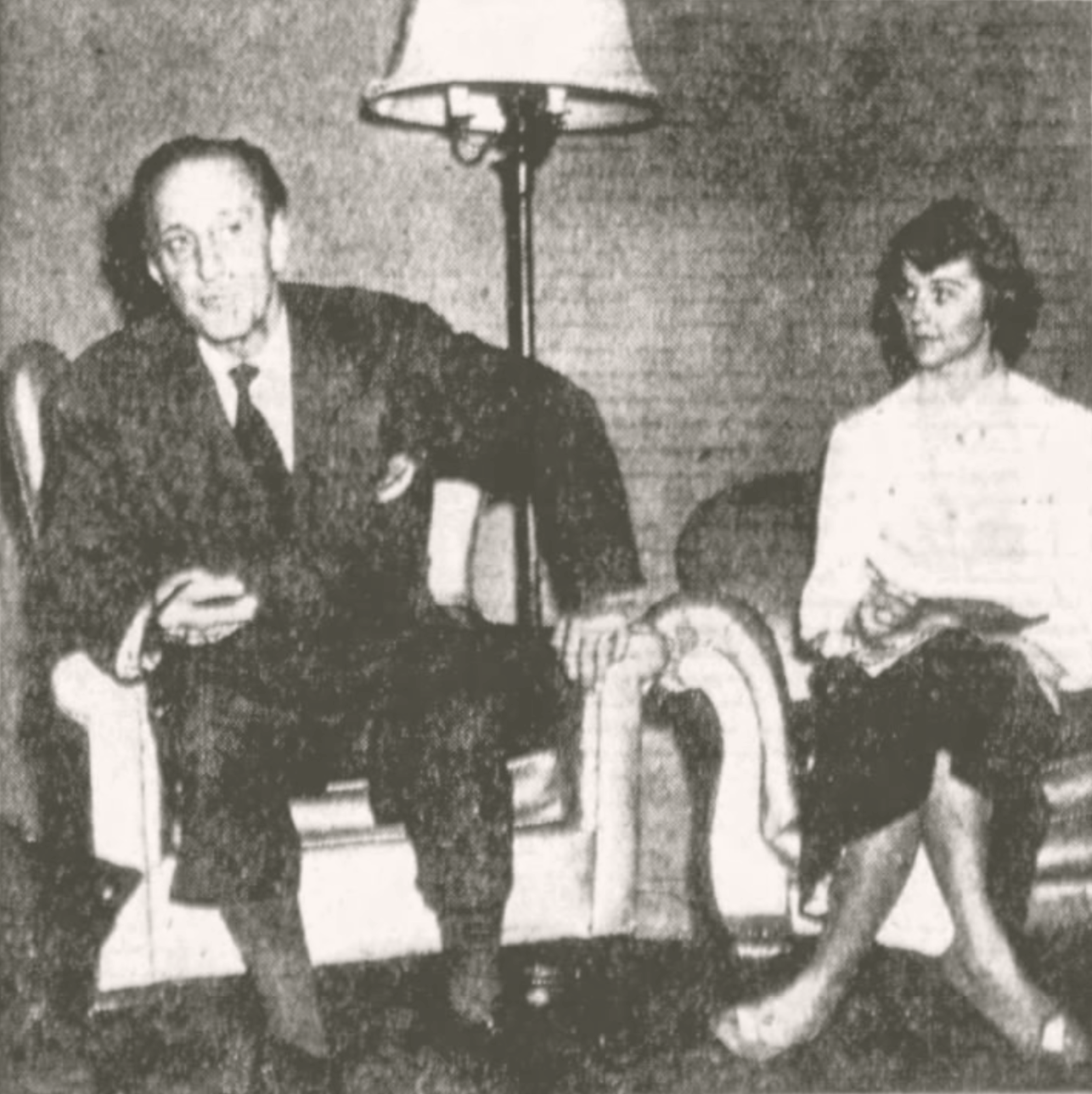
Famed Actor-Lecturer Is In TownBASIL RATHBONE, noted actor, was interviewed here this noon during a press conference at Hotel lembke by a Valparaiso university student.(V-M Staff Photo)

Famed Actor-Lecturer Is In Town

BASIL RATHBONE, noted actor, was interviewed here this noon during a press conference at Hotel lembke by a Valparaiso university student.

(V-M Staff Photo)

The noted actor, here for a workshop lecture on phases of the theater today, and a formal appearance Wednesday at 8:15 p.m., at Valparaiso university’s auditorium, said that mystery books were “simply not my cup of tea.”

Attired in a natty gray flannel suit, the debonair Rathbone told a group during an interview this noon, that although he felt that playing the role of the famous detective had almost “typed” hom professionally, he still would never grow tired of the Sir Conan Doyle role.

?Maybe I would tire of doing 16 pictures and 200 broadcasts of Hamlet, but never Sherlock Holmes,” he told the group.

No Violin Player

Rathbone clarified the fact that he does not play the violin such as portrayed in the Holmes television series.

“I actually learned to go through the motions of fingering and bowing the instrument. What little music did spring forth, dear pictures, they cut it out.”

Although the famous words “elementary, my dear Watson,” make it appear that solving mysteries are his forte, Rathbone said that he would have no desire to enter the detective profession. The Sherlock Holmes series has not as yet increased my powers of observation and deduction,” he said.

In a more serious vein, Rathbone said that not everyone can become an effective speaker. “First you must have something to say. When you have the subject, you must then have the ability to speak concisely and intelligently.”

2 Outstanding Speakers

Two prime examples in Rathbone’s estimation of outstanding speakers today are Mrs. Eleanor Roosevelt and Sir Winston Churchill. It was Churchill whom he remembers as saying “everyone should learn to speak on their feet.”

“Unlike the theater, cinema or television, public speaking is a cold turkey proposition, with no stage, no lights, no orchestra,” the noted Shakespearean player pointed out.

Rathbone, who will appear Wednesday in a presentation of selections from the world’s great literature, including poetry, prose and drama, also made it clear that he did not look upon himself as a good speaker.

“I feel that the only reason that people listen to me at all is because they merely wish to find out what kind of a man I am.”

He was frank in stating that he preferred talking to women’s clubs as compared to male organizations. “Women at least make you welcome.”

Rathbone’s appearance here is sponsored by the Department of Speech and Drama of Valparaiso university.

April 30, 1981: Students take over

Originally published in The Vidette-Messenger of Porter County on April 30, 1981.

Students take over

4.30.1981 pic (1).png

Taking over for Mayor Elden Kuehl (above) and taking the oath of office for sheriff (below) are two VHS students elected to one-day terms of office. Mayor-for-a-day Trent Albert reviews the city’s budget with Kuehl. Sheriff-for-a-day Todd Van Keppel is sworn in by Porter County Sheriff Tim McCarthy. Several VHS seniors will be serving in city and county offices today as part of Student Government Day sponsored by VHS government teachers and the Valparaiso Jaycees.

4.30.1981 pic2.png