
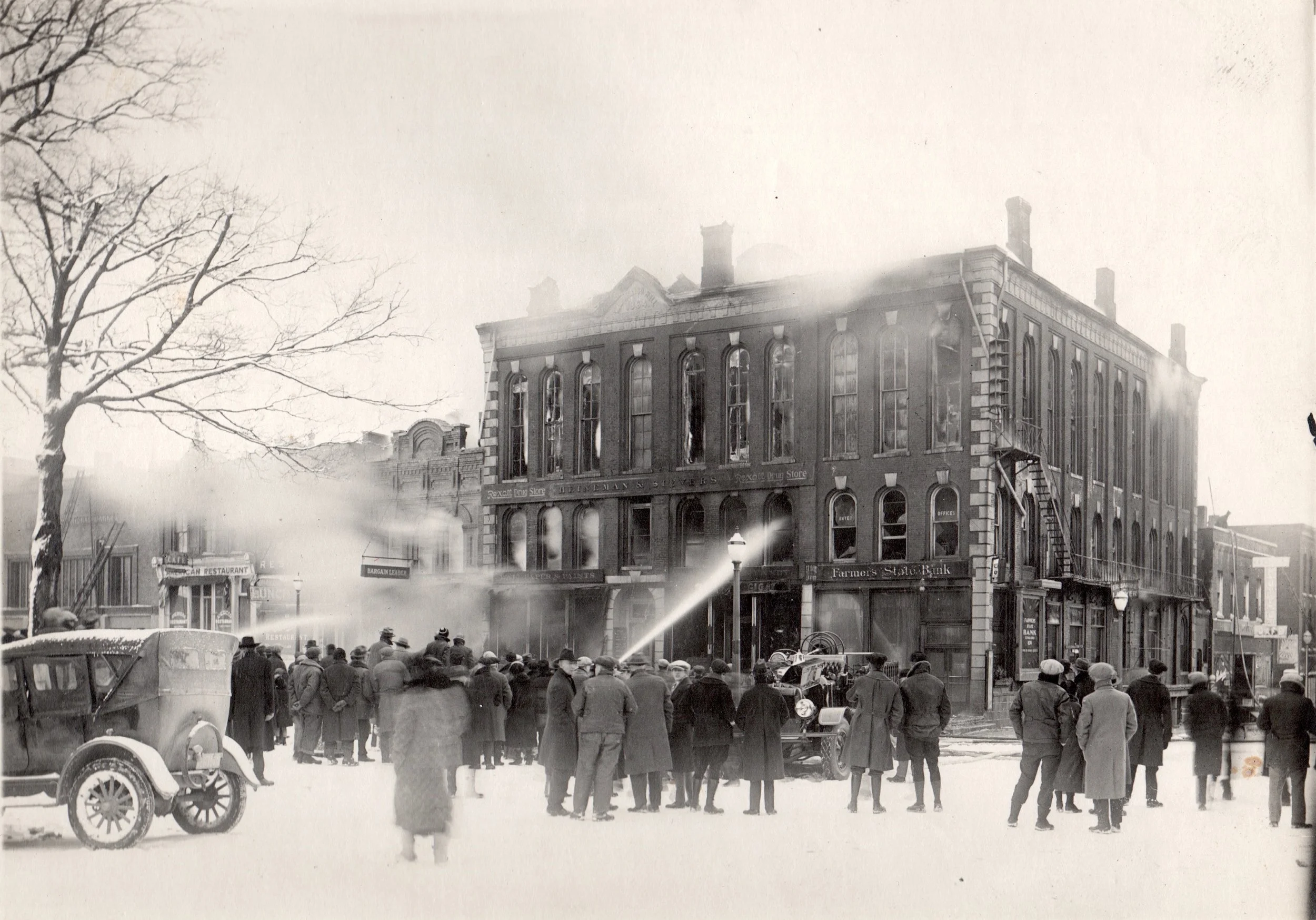
The Academy of Music Block burns in downtown Valparaiso on February 19, 1926
Loss of $250,000 Was Incurred in Fire That Destroyed Landmark of Valparaiso.
REVIEW IS GIVEN OF TRAGIC BLAZE
(This story was written by Englebert Zimmerman for The Vidette-Messenger on February 19, 1936)
Ten years ago today, February 19, 1926, one of Valparaiso’s commercial hubs and historic landmarks was leveled by fire.
At 6 o’clock in the morning with the temperature five degrees below, flames starting in the boiler room of the Academy of Music block, owned by H. H. Loring, president of the First State Bank of Valparaiso, and former judge of the Porter circuit court, resulted in property damage of between $250,000 and $300,000.
Half a dozen business firms, four attorneys and one abstracter suffered heavy losses. In addition to the Academy of Music block, the building occupied by the Valparaiso Bargain Leader was completely destroyed.
To the staggering property destruction of the flames was added the loss of two lives and injury to half a dozen persons, caused when a wall of the Academy of Music building toppled over onto the Bargain Leader building.
Those killed were: Harry McNamara, Gary truckman, one of six Steel City firemen to come to the aid of Fire Chief Fred Wittenberg when he flashed the call for assistance, and J. Robert Bartholomew, trouble man for the Northwestern Indiana Telephone company, who volunteered his services in fighting the fire.
Those injured included Lieutenant Richard Brown, of the Gary department; Claus Helmick, local painter; Lloyd (Mud) Miller, blacksmith employed by Chief Wittenberg, and Oscar Billings, Gary fireman.
Others nearly trapped in the catastrophe were County Surveyor William E. Morthland, who suffered head bruises; Harvey O. Varner, former commander of the American Legion post, rescued from the crash when comrades grabbed him as he stood upon the ledge; Ray Dean, volunteer fireman; Charles Gilliland, then commander of the local legion post, and several other volunteer firemen.
The crash came ten minutes after Sheriff W. B. Forney had passed over the roof of the Bargain Leader building where the fire fighters were gathered, pleading with the men risking their lives to draw back. The sheriff had noted with horror the swaying of the black red-hot wall.
Yet they stayed at their posts, defying the catastrophe which shortly came upon them. The complete tragedy was so swift none trapped realized what had happened. They heard a crash and then in the words of Lieutenant Brown of the Gary department, “all went black.” The victims, the floors beneath them giving way as the tons of brick of the great south wall crashed in upon them, were hurled through two floors of space into the mass of ruins in the basement, even then well filled with water.
Claus Helmick was the first to be taken to Christian hospital. Lieutenant Brown soon followed and led by Fire Chief Wittenberg the work of rescue was pressed for half an hour before the body of Robert Bartholomew was recovered. Then followed the safe removal of Oscar Billings, and finally after an hour and a half of suspense, the finding of Lloyd Miller who passed through the ordeal safely, though shocked by the cold water.
It was 3 o’clock in the afternoon, nearly five hours after the crash, that the body of McNamara was finally recovered.
McNamara was holding the nozzle of the hose with Lieutenant Brown when the crash came. Some heavy scudding interposed between Brown and McNamara, to which Brown owes his life.
On hand to claim the body of McNamara was Mayor Floyd Williams of Gary, Chief Gray and other Gary officials. They took a part in directing the search for the body.
Firms losing in the fire were:
Farmers State bank, $5,000 in fixtures; all records saved.
Bargain Leader store, owned by Louis Kauffman and Company, loss $25,000.
Sievers Drug Company, entire stock and all fixtures destroyed, loss $10,000.
Law offices of Daniel E. Kelly, with library of 1,500 volumes valued at $8,000; former Mayor E. W. Agar, estimated loss $3,500; E. C. Osborne, estimated loss $3,000; Frank A. Turner, abstract office, loss $5,000; Attorneys P. J. Bailey and Prosecutor W. W. Bozarth, whose offices were destroyed, suffered complete losses involving property valued at $4,000.
Griebel and Vevia barber shop, complete loss; John W. Truman tailor shop, complete loss; Barnes Yellow Taxicab office, complete loss; Tobin pool room, complete loss.
Furnishings removed from the Farmers’ restaurant were badly water soaked; also house furnishings of Mrs. Floyd Bonnell, residing over the Bargain Leader store.
The flames started in the boiler room under the Tobin pool room which was of cement floor construction covered with fire resisting sheet-rock.
August Koch, janitor, built a fire at 5 o’clock and an hour later when about to return to the building, was notified of the outbreak. The alarm was sent in by August Schumacher. When it was seen local firemen were unable to cope with the blaze, Chief Wittenberg decided to send a call to Gary for help. Policeman Matthew Brown put in the call. Eight lines of hose were played on the burning inferno.
The Academy of Music block was built in 1864 by Samuel Anthony and Ruel Starr, and was one of the city’s commanding business structures. Passing into the direction of the Starr estate, James M. McGill assumed management and in 1908 sold it to Judge H. H. Loring.
For nearly thirty years the third floor of the building had been headquarters for the Masonic lodge and, prior to occupancy by the Masons was the city's principal theatre.
The Sievers Drug Company operated its store in the building since 1900, and the Farmers' bank since its organization.
The Bargain Leader store building was owned by C. L. Jeffrey and A. A. Hughart. It was a total loss.
Valparaiso paid tribute to those who lost their lives in the fire on Monday, February 22, when Valparaiso citizens strongly backed up an appeal by Mayor W. F. Spooner to set aside the day in paying testimonial to the brave fire fighters.
Local officials attended rites in Gary for Harry McNamara in the morning, and services for Robert Bartholomew in the afternoon.
Less than a week after the fire the entire city got behind an appeal made by Arthur J. Bowser for raising a $10,000 benefit fund for the dead firemen and those who were injured. So great was the response that the fund was oversubscribed. Every cent of the fund was disbursed to families of the men killed and those injured.
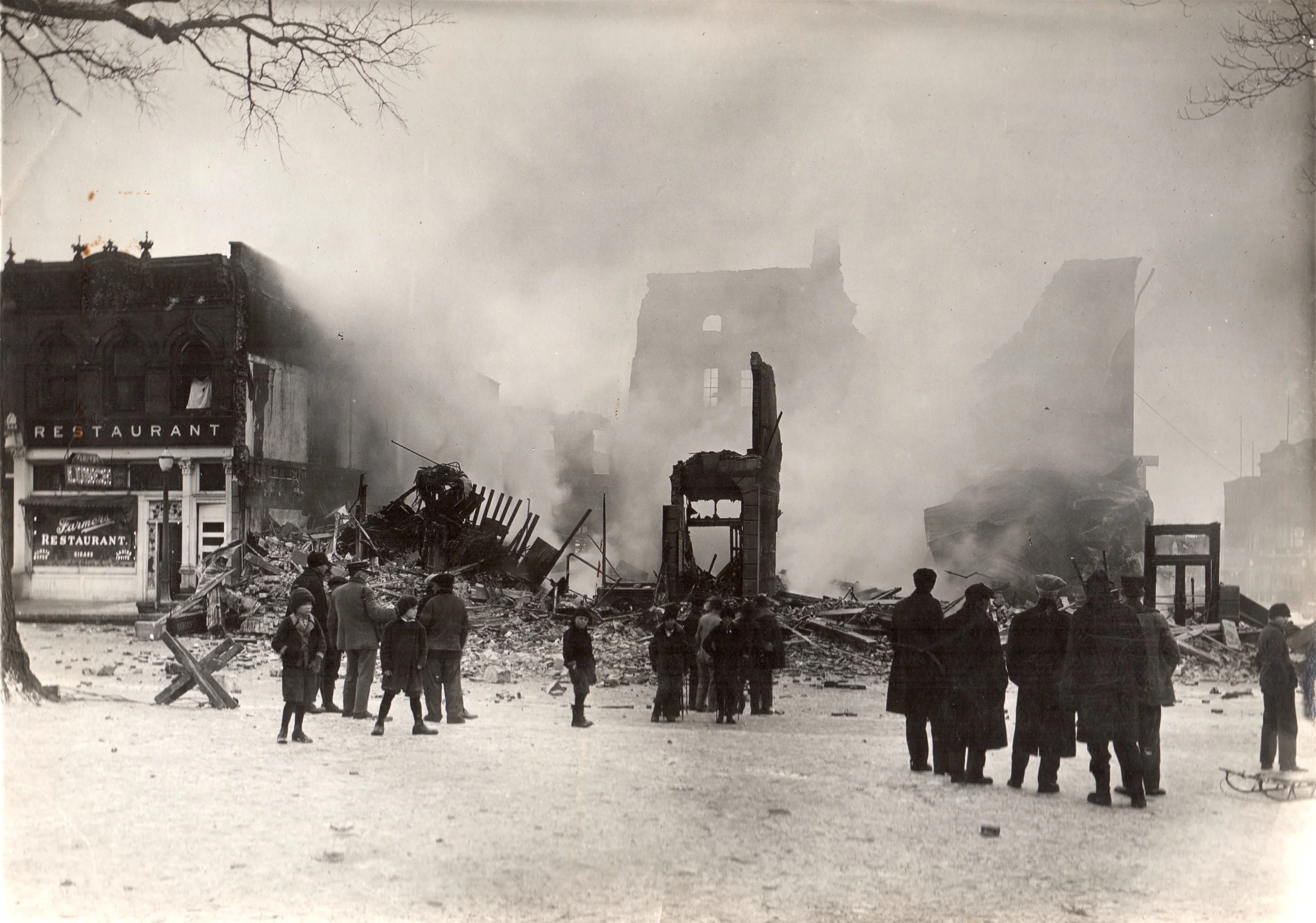
Aftermath of the Academy of Music Block on February 19, 1926